The rate follows how the time was coded, not what the job was called
An owner opens an invoice where the labor is wrong, goes into the rate card looking for the mistake, and finds the rate card is right.
You open an invoice and the labor is wrong.
Four hours on a commercial account. It billed at ninety five an hour. That customer’s agreement says journeyman work bills at a hundred and forty five. So the invoice is two hundred dollars short, and it does not look short, because every line on it is filled in.
You go into the rate card looking for the mistake.
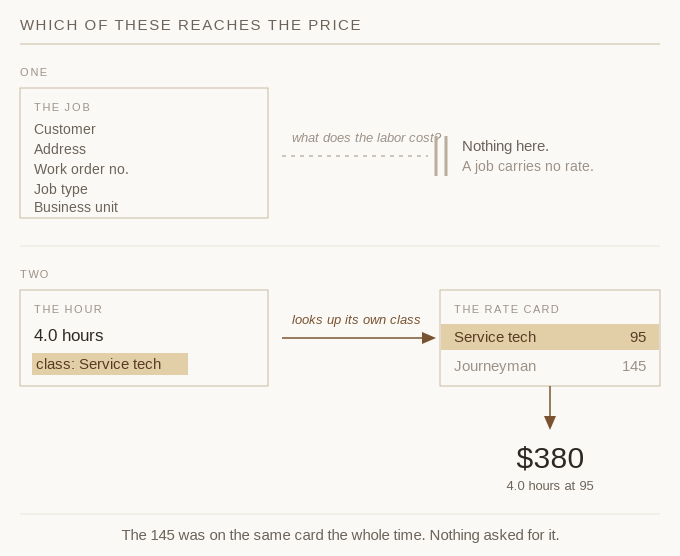
The card is right. Service tech, ninety five. Journeyman, a hundred and forty five. Both numbers are sitting there, exactly the way you agreed them.
Nobody wrote journeyman on the hours.
The card never made a choice
It answered a question. And the question did not come from the job.
This is the part that hides, because the job is the loud thing. A job has a customer on it, an address, a work order number, a description of what broke. All of that feels like it should decide what the labor costs.
It decides nothing about the labor.
There are two records of the same four hours, and they are not the same record. One says what the work was. Commercial, no cooling, upstairs unit. The other says how the time was classified. Four hours, service tech.
The price reads the second one. Every time.
Where the money actually leaks
The classification usually gets set once, on the person. Whoever the man is, that is what his hours get coded as from then on, unless somebody changes it on that ticket.
Works fine until the day it does not.
Your journeyman covers a service call because the service tech called out. He is a journeyman. He did journeyman work. His hours go in as journeyman. Nothing wrong there.
Now turn it around. Your service tech ends up on work that bills at the journeyman rate. He is coded service tech. Nobody touched it. The invoice goes out at ninety five.
That two hundred is gone. Not disputed, not argued down, just gone. And the paper looks right, so nobody goes looking for it.
Software does not fix this, it enforces it
ServiceTitan does it the same way, and it is worth seeing, because the shape is easier to make out when a machine is doing it.
The labor item in the pricebook sits there with the price field deliberately left empty. The rate does not live on the item. It lives in a table that joins a classification to a dollar figure. What picks the row out of that table is the classification recorded on the hour, and nothing about the job touches it.
ServiceTitan even warns you to give every technician a default classification, because a man with none produces an hour that has nothing to look up.
A paper rate card does exactly the same thing. It just lets you get away with more.
What to do with this
When the labor on an invoice is wrong, the rate card is the last place to look.
Go find the hour. Ask three things. What did it get coded as. Who coded it. And does anybody ever change it when the man doing the work is not the man the system expects.
Mostly nobody does, right? That is not a software problem. That is a paper habit that followed everybody into the software.
Every one of these is something I watched happen in a real book. The principle above is what they add up to.